This page contains affiliate links. If you buy through them we may earn a commission at no extra cost to you. How we make money
Crawl Space Dehumidifier Size Calculator
Enter your crawl space floor area, height, current moisture condition and climate. The calculator returns a capacity in pints per day, on the same 80°F rating the units are sold on, plus the 65°F equivalent, and lists the units we cover that meet it.
Recommended capacity
130pints/day (AHAM, 80°F)
About 82 pints/day on the 65°F DOE rating that ENERGY STAR uses. Compare units on one basis or the other, not across both.
Why this number
Base load: 1,500 sq ft ÷ 1,000 × 70 pints (IRC R408.3) = 105 pints/day.
Moisture (damp): × 1 (our assumption).
Height (3 ft vs. a 3 ft reference): × 1 (our assumption, floored at 0.8 and capped at 2.0).
Climate (humid): × 1.2 (our assumption).
Result: 126 pints/day, rounded up to the next capacity actually sold (55, 70, 80, 85, 90, 100, 102, 120, 130 pints) = 130 pints/day. The 65°F figure is that × 0.63.
Units that meet this capacity
Cheapest verified price first, with at least one built-in-pump option when one qualifies. Coverage claims are the manufacturer's and assume a sealed crawl space.
Capacity is the amount of water a dehumidifier can pull out of the air in 24 hours, stated in pints per day. The right capacity depends on how much water vapor enters the crawl space (from soil, outdoor air and the house above) and how fast you want to bring humidity down. Nobody can measure that load from a form, so every sizing method, including this one, starts from floor area and adjusts for the things that make a crawl space wetter than average.
Our base rate comes from the building code rather than from a manufacturer. The International Residential Code, in section R408.3 on unvented crawl spaces, requires a Class I vapor retarder over exposed earth and then one of several ways to condition the space. Item 2.4 reads: “Dehumidification sized to provide 70 pints (33 liters) of moisture removal per day for every 1,000 square feet (93 m2) of crawl space floor area.” That is 70 pints per 1,000 square feet, or 7 pints per 100 square feet, and it first appeared in the 2018 IRC. Not every state adopted it as written: South Carolina replaced it with “Dehumidification sized in accordance with the manufacturer's specifications,” so check your local code if you are permitting the work.
AHAM pints versus DOE pints
Every pint rating carries a test condition, and the two conventions differ by roughly 40 percent. Before 2019, dehumidifiers were rated at 80°F and 60% relative humidity, the AHAM condition. According to ENERGY STAR, “DOE finalized new energy conservation standards for dehumidifiers that took effect in June 2019,” and since then “portable dehumidifiers are tested at 65°F, rather than 80°F, to more accurately reflect expected performance in a basement setting.” The result is smaller numbers for the same hardware: “There's less water to remove in cooler air, which is why the capacities have decreased.”
ENERGY STAR publishes this conversion between the two ratings, in pints per day:
ENERGY STAR conversion, old 80°F rating to new 65°F rating
Old rating (80°F / 60% RH)
New rating (65°F / 60% RH)
30
20
40
25
50
30
60
35
70
40-45
90
55
Crawl space units are still marketed on the 80°F figure, and the code's 70 pints is on that basis too, so the calculator recommends in AHAM pints. The 65°F equivalent is that number times 0.63, which is where the ENERGY STAR table lands; Santa Fe's own Compact70 spec sheet (70 pints at 80°F, 43.7 at 65°F) is 0.62. A crawl space in summer sits closer to the 65°F condition than the 80°F one, which is one reason to round up rather than down.
Why manufacturer coverage claims disagree
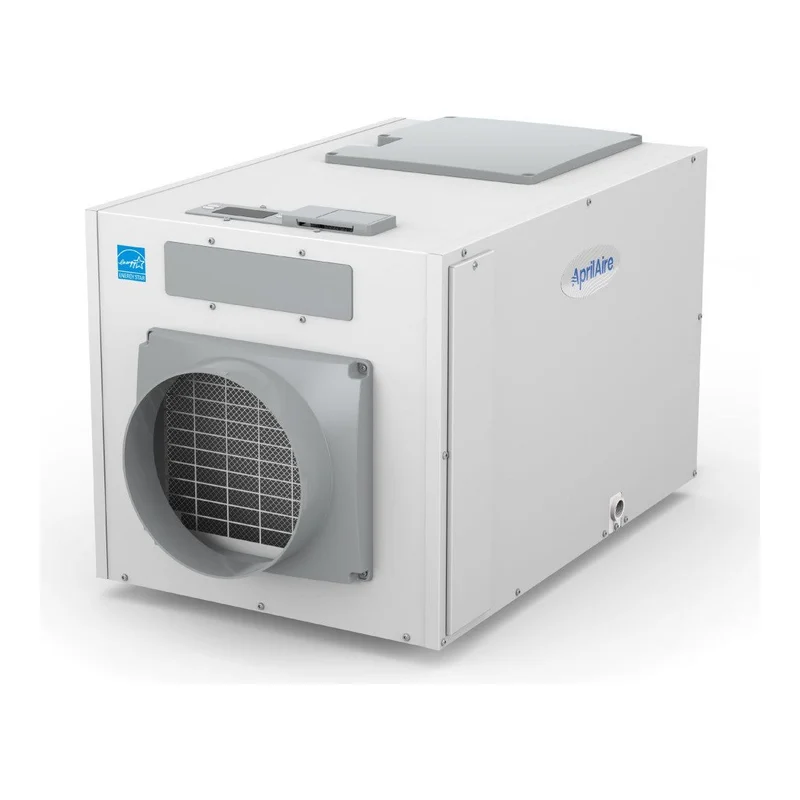
Every product page carries a square-foot figure, and they are not comparable. Santa Fe rates the Compact70 for crawl spaces at “Tightly Sealed - Up to 2,600 Sq. Ft.,” “Moderately Sealed - Up to 2,200 Sq. Ft.” and “Loosely Sealed - Up to 1,800 Sq. Ft.,” and defines loosely sealed as “older homes with very minimal air sealing and foundations with several cracks and imperfections.” AprilAire claims 2,200 sq ft for its 70-pint E070, 4,400 for the 80-pint E080 and 5,500 for the 100-pint E100. AlorAir claims 2,600 sq ft for the 90-pint Sentinel HDi90.
Put those on one scale and AprilAire is claiming 31 to 55 sq ft per AHAM pint depending on model, Santa Fe about 31 on a moderately sealed space, and AlorAir 24 to 29. Coverage is marketing, not a standard, and all of it assumes an encapsulated crawl space with a vapor barrier over the soil. Sizing from the code rate instead of the claim is why our result will often be a size larger than a product page suggests. If the crawl space is vented or the soil is bare, read dehumidifier vs. encapsulation first; no capacity number fixes an open crawl space.
What humidity to aim for
The EPA's mold guidance says “Indoor relative humidity (RH) should be kept below 60 percent -- ideally between 30 percent and 50 percent, if possible,” and notes that “Crawl spaces where relative humidity (RH) is high are common sites of hidden mold growth, particularly if the crawl space has a bare earth floor.” Set the unit to 50 to 55 percent (Santa Fe's Compact70 manual calls 45 to 55 percent its “Normal” range), and a $15 hygrometer at the far end of the crawl space tells you whether it is getting there.
What we assume
Only the base rate is sourced. The three multipliers are our editorial assumptions, and you should know what they are:
Base load (sourced, IRC R408.3): floor area ÷ 1,000 × 70 pints per day. We treat this as a sealed, damp crawl space in a moderate climate.
Moisture condition (editorial): dry ×0.75, damp ×1, wet ×1.3, standing water ×1.6. The ratios mirror the spread in ENERGY STAR's residential sizing guidance, which recommends 20 to 30 pints for a slightly damp space under 2,000 sq ft, 25 to 40 for a very damp one and 30 to 50 for a wet one (65°F pints). Standing water is a drainage problem; the multiplier is a stopgap, not a fix.
Height (editorial): height ÷ 3 ft, floored at 0.8 and capped at 2. Code and manufacturers size on floor area and assume a typical 2 to 4 ft crawl space; a taller volume holds proportionally more air. No standard publishes a height factor.
Climate (editorial): dry ×0.85, moderate ×1, humid ×1.2. No standard publishes climate factors either; the nearest analogue is Santa Fe's loosely-versus-tightly sealed spread of about 18 percent each way.
Rounding: up to the next capacity actually sold among the units we cover (55, 70, 80, 85, 90, 100, 102, 120, 130 pints). Below 55 we still recommend 55, because crawl space units start there; above 130 we suggest two units or a professional design.
Cross-check: 1,500 sq ft, 3 ft high, damp, humid climate gives 126 pints and rounds to 130. Santa Fe rated its 100-pint Advance100 for 2,400 sq ft moderately sealed (per a reseller quoting Santa Fe copy), so in humid climates the calculator runs conservative. We would rather you buy one size up than watch a unit run 24 hours a day and never reach its setpoint.
When to hire it out
Sizing is the easy part. If the result is above the largest single unit, if the crawl space is divided by foundation walls, if condensate has to be pumped up and out, or if the space needs encapsulation before a dehumidifier makes sense, get quotes. The installation guide walks through placement, drain routing and power, and the installer directory lists crawl space contractors by state and city. For the units themselves, start with the best crawl space dehumidifiers list, the built-in pump models if gravity drain is out, and the cost guide for what unit plus installation runs.
Frequently asked questions
How many pints per day does a crawl space dehumidifier need per square foot?+
The building code figure is 70 pints per day for every 1,000 square feet of crawl space floor area (IRC R408.3, item 2.4), which works out to 7 pints per 100 square feet. That is on the older 80°F AHAM rating that crawl space units are marketed on. Treat it as the baseline for a sealed, damp crawl space in a moderate climate, then add capacity for a wet space, a tall crawl space or a humid climate.
Is it better to oversize a crawl space dehumidifier?+
Within reason, yes. A unit with headroom reaches its setpoint faster, cycles off and runs fewer hours, and crawl spaces are cooler than the 80°F test condition, so a unit delivers less than its rated capacity in practice. The cost is a larger cabinet that may not fit the access door and a higher purchase price. Our calculator rounds up to the next capacity that is actually sold rather than to the nearest one.
Why does my calculator result differ from the manufacturer's coverage claim?+
Coverage claims are marketing, not a standard, and they vary widely: AprilAire claims 31 to 55 sq ft per AHAM pint depending on model, Santa Fe about 31 on a moderately sealed space, and AlorAir 24 to 29. All of them assume an encapsulated crawl space with a vapor barrier. Our base rate comes from the building code, and the humid-climate multiplier makes the result deliberately conservative, so it will often recommend a larger unit than the claim alone would.
What is the difference between 80°F and 65°F pint ratings?+
Before June 2019, dehumidifiers were rated at 80°F and 60% relative humidity. The DOE test now runs at 65°F, which is closer to a basement or crawl space, and yields a lower number because cooler air holds less water. ENERGY STAR's conversion table runs 50 to 30, 70 to 40-45 and 90 to 55, roughly 0.6 to 0.65. Crawl space units are still sold on the 80°F figure, so we recommend in those pints and show the 65°F equivalent alongside.
What humidity should a crawl space be kept at?+
The EPA says indoor relative humidity should be kept below 60 percent, ideally between 30 and 50 percent, and singles out crawl spaces with a bare earth floor as common sites of hidden mold. Santa Fe's Compact70 manual calls 45 to 55 percent its Normal range, and 50 to 55 percent is a sensible target. Going much lower costs run time without much benefit; going above 60% lets mold and wood-rot fungi grow on framing.
Sources
Quotations above are verbatim from these pages as read on 2026-09-29. These are reference links, not affiliate links.