There are three separate bills behind a crawl space dehumidifier: the unit, the installation, and the electricity to run it for the next ten years. Most cost articles blur them together, and the biggest one, encapsulation, is often quietly folded into the "installation" figure. This guide keeps them apart. Unit prices below are the ones we verified on the retailer pages in our product data, with the date we read them. Installation and encapsulation ranges are quoted from published cost guides with links and dates, because we do not install units and will not invent a number. Running cost is a worked calculation you can redo with your own electric rate.
What the unit costs
Crawl space dehumidifiers are a different class of product from the $200 portable units sold for bedrooms. They are rated at 55 to 130 pints per day on the older 80°F AHAM standard, built to run in a 3 ft high space at 65°F, and carry 5- and 6-year warranties. The table below is generated from our product data; every price is one we read on the named retailer's page on the date shown, not a manufacturer's suggested price.
Verified crawl space dehumidifier prices by model| Model | Pints/day (80°F) | Pump | Price | Read at |
|---|
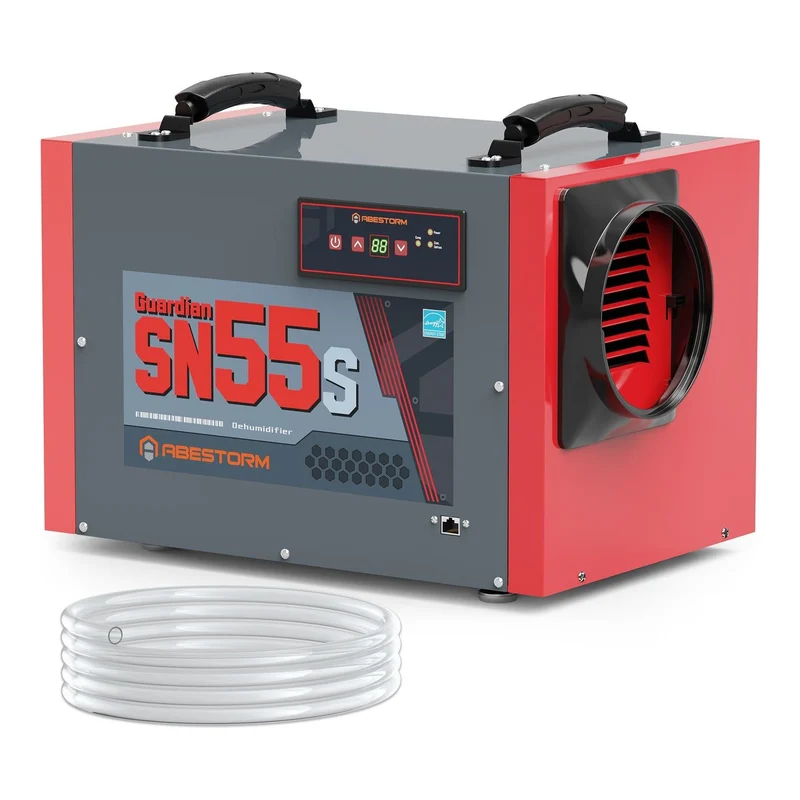
| Abestorm Guardian SN55S | 55 | No | $454 (sale) | Abestorm, Oct 2026 |
| AlorAir Sentinel HD55S | 55 | No | $649 | Sylvane, Oct 2026 |
| Abestorm Guardian SNS65 | 55 | Built-in | $681 (sale) | Abestorm, Oct 2026 |
| Abestorm Guardian SNS90 | 90 | Built-in | $746 (sale) | Abestorm, Oct 2026 |
| AlorAir Sentinel HDi65S | 55 | Built-in | $755 | Sylvane, Oct 2026 |
| AlorAir Sentinel HDi90 | 90 | Built-in | $1,147 | Sylvane, Oct 2026 |
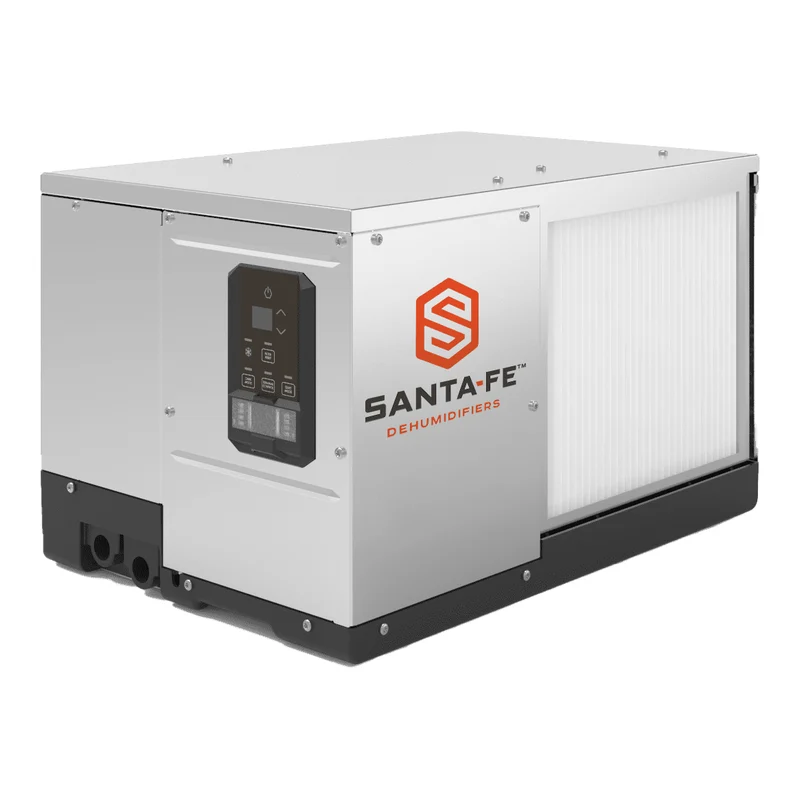
| Santa Fe Compact70 | 70 | No | $1,365 (sale) | Sylvane, Oct 2026 |
| AlorAir Sentinel HDi100 | 100 | Built-in | $1,399 | Sylvane, Oct 2026 |
| AprilAire E070 | 70 | No | $1,400 (sale) | Sylvane, Oct 2026 |
| AprilAire E080 | 80 | No | $1,495 (sale) | Sylvane, Oct 2026 |
| AlorAir Sentinel HDi120 | 120 | Built-in | $1,599 | Sylvane, Oct 2026 |
| AprilAire E100 | 100 | No | $1,878 (sale) | Sylvane, Oct 2026 |
| Santa Fe Oasis105 | 102 | No | $2,108 (sale) | Sylvane, Oct 2026 |
| AprilAire E130 | 130 | No | $2,496 (sale) | Sylvane, Oct 2026 |
| Seaira Global WatchDog NXT85C | 85 | Built-in | Not verified | — |
Three patterns in that table are worth knowing before you shop. First, the price gap between a 55-pint and a 70-pint unit is larger than the gap between 70 and 90 pints, so if the size calculator lands you at 70, the step up to a 90-pint pump unit costs less than you would expect. Second, built-in pumps do not add much at the register: AlorAir's HDi65S costs about $106 more than the drain-hose HD55S of the same capacity at Sylvane. Third, sale prices matter. Two Abestorm units in our data were marked down by roughly a third on the manufacturer's site when we checked, which is why the SNS90 is the best-value pick and the SN55S the budget entry on the best crawl space dehumidifiers list. Sale prices change; check the current price before you decide.
What installation costs
Installation labor depends on whether the crawl space is already sealed, because a contractor will not (and should not) hang a dehumidifier in a vented crawl space with bare soil. Published figures separate cleanly along that line.
According to HomeGuide (December 2025), the unit alone costs $300 to $2,000, labor to install it runs $700 to $1,000, and the average total with installation is $1,000 to $3,000. HomeGuide puts HVAC technicians at $75 to $150 per hour and a handyperson at $50 to $80 per hour.
According to Angi (July 2026), crawl space dehumidifier installation averages $7,000 with a range of $1,500 to $14,000. That figure is not a typo; Angi states it priced the page assuming the crawl space also needs encapsulation, and says that if the crawl space is already encapsulated, a dehumidification system will likely cost $1,000 to $4,000. Angi puts labor at $50 to $120 per hour.
Read together, those two sources say the same thing: for an already-sealed crawl space, budget roughly $700 to $1,000 of labor on top of the unit, and a total of $1,000 to $3,000. If the crawl space still needs a vapor barrier and sealed vents, the job is an encapsulation project with a dehumidifier at the end of it, and the sourced encapsulation ranges are on our dehumidifier vs. encapsulation page.
What moves labor within that range: whether a gravity drain is possible or a condensate pump and lift line are needed; whether a GFCI receptacle already exists under the house or an electrician has to add one; the crawl space height and hatch size; and ducting, which Angi lists separately at $450 to $2,000 as a material line on its encapsulation page. The installation guide describes each of those tasks so you can tell which ones apply to your house, and the installer directory lists contractors by state and city if you want quotes.
What it costs to run
Manufacturers publish amperage, not monthly cost, so here is the arithmetic. It is an estimate; the assumptions are listed so you can swap in your own.
Worked example. The AlorAir Sentinel HDi90 spec sheet lists 5.56 A at 115 V. Volts times amps is watts, so the unit draws about 5.56 × 115 ≈ 640 W while the compressor runs. Over one hour that is 0.64 kWh. The U.S. Energy Information Administration's Electric Power Monthly, Table 5.6.A puts the average residential price at 18.31 cents per kWh for July 2026, with North Carolina at 15.16, Florida at 15.03, Texas at 15.88 and Georgia at 16.27 cents. At the national average:
Estimated monthly electricity cost for a AlorAir Sentinel HDi90 crawl space dehumidifier| Compressor hours per day | kWh per month (30 days) | Cost per month |
|---|
| 4 | 77 | $14 |
| 8 | 153 | $28 |
| 12 | 230 | $42 |
| 24 | 460 | $84 |
Assumptions: AlorAir Sentinel HDi90 at 5.56 A × 115 V ≈ 639 W while running; 18.31¢ per kWh (EIA U.S. residential average, July 2026); 30-day month; fan-only and standby draw ignored. Multiply by your own rate ÷ 18.31 to localize.
Where you land in that table depends on how many hours a day the compressor actually runs, and that is driven by how well the crawl space is sealed and how big the unit is relative to the load. In a tightly encapsulated crawl space with a correctly sized unit, our estimate is 4 to 8 hours a day through the humid season, with the compressor running far less from November through March in most of the Southeast. A vented crawl space can push the unit toward 24 hours a day and still miss the setpoint. Published estimates agree with the spread: HomeGuide (December 2025) says running a dehumidifier costs $10 to $30 per month on average, and Angi (July 2026) says homeowners can expect an annual electric bill increase of around $300 to $500, which can drop if the crawl space is properly encapsulated.
Energy factor. The efficiency figure to compare is the integrated energy factor, in liters of water removed per kilowatt-hour. ENERGY STAR's dehumidifier page explains the metric and states that certified dehumidifiers are 20 percent more efficient than non-certified models. Manufacturers publish it under different names: AlorAir and Abestorm list a "COP" of 2.69 L/kWh for their 90-pint units and 2.4 L/kWh for the 55-pint ones; AprilAire lists an energy factor of 2.6 L/kWh for the E100 and 2.9 L/kWh for the E130. Turn that around and a 2.69 L/kWh unit uses about 0.37 kWh per liter, so removing 20 liters (about 42 pints) on a bad day costs roughly 7.4 kWh, or about $1.36 at the national average rate. A 2.4 L/kWh unit doing the same job uses about 8.3 kWh. Over a season the difference is real but modest; the sealing of the crawl space matters far more than the last 10 percent of efficiency.
Cost by crawl space size
The table below combines the sizing calculator's method (the IRC R408.3 base rate of 70 pints per day per 1,000 sq ft, for a damp crawl space of typical height in a moderate climate) with the verified prices in our product data. It lists the recommended capacity for a representative floor area in each band and the cheapest units in our data that meet it. Humid-climate and wet crawl spaces push the recommendation up a tier; run your own numbers in the size calculator.
Crawl space dehumidifier cost by crawl space size| Crawl space size | Example floor area | Recommended capacity | Cheapest units that meet it (verified price) |
|---|
| Small (under 1,000 sq ft) | 800 sq ft | 70 pints/day | Abestorm Guardian SNS90 $746; AlorAir Sentinel HDi90 $1,147; Santa Fe Compact70 $1,365 |
| Medium (1,000 to 2,000 sq ft) | 1,500 sq ft | 120 pints/day | AlorAir Sentinel HDi120 $1,599; AprilAire E130 $2,496 |
| Large (over 2,000 sq ft) | 2,500 sq ft | 130 pints/day (raw load exceeds largest single unit) | AprilAire E130 $2,496 |
Capacity from the size calculator's method: 70 pints/day per 1,000 sq ft (IRC R408.3), damp, 3 ft high, moderate climate, rounded up to the next capacity sold. Prices are the verified figures in our product data on the dates shown in the unit table above.
Add the sourced labor range of $700 to $1,000 to the unit price for an installed cost in an already-sealed crawl space. Above about 2,000 sq ft the calculator often lands above the largest single unit, in which case the practical options are two smaller units, one ducted large unit, or a contractor's design, and the labor side grows accordingly.
Encapsulation cost
If your crawl space is vented or has bare soil, the dehumidifier is the last line item of a larger job. We keep the sourced encapsulation ranges, from three published cost guides with dates, on the dehumidifier vs. encapsulation page rather than repeating them here.
Ways to save
- Size it right, then buy one step up, not three. Oversizing by one tier means shorter run cycles and lower monthly cost. Oversizing by three tiers means paying for capacity that never runs. Use the calculator.
- Choose an ENERGY STAR unit when the price is close. The 20 percent efficiency figure comes from ENERGY STAR itself; several of the units in our table carry the mark.
- Watch for sale pricing. The two largest discounts in our data were on the manufacturer's own store, not at a big-box retailer. Prices in our table carry the date we read them for exactly this reason.
- Do the drain yourself. A gravity drain or a condensate pump kit is an afternoon's work; the installation guide walks through it. If you only pay a pro for the electrical receptacle, the labor line shrinks.
- Seal first. Every published source agrees, and so does the physics: a dehumidifier in a sealed crawl space runs a fraction of the hours one in a vented crawl space does. The electricity you do not buy pays back the vapor barrier.
- Change the filter. A clogged filter reduces airflow and capacity, which means longer run time for the same water removed.
- Get three quotes. HomeGuide and Angi both recommend it, and installed-price quotes for the same unit vary by more than the unit's price.